How many stocks do you actually need to feel safe? You’ve heard the old advice: own 10-15 stocks and you’re diversified. But what if that’s not enough? What if owning 30 still leaves you exposed? And what if owning 100 doesn’t make you any safer? The truth is, there’s no magic number. But there is a better way to think about it.
Why 15 Stocks Isn’t Enough Anymore
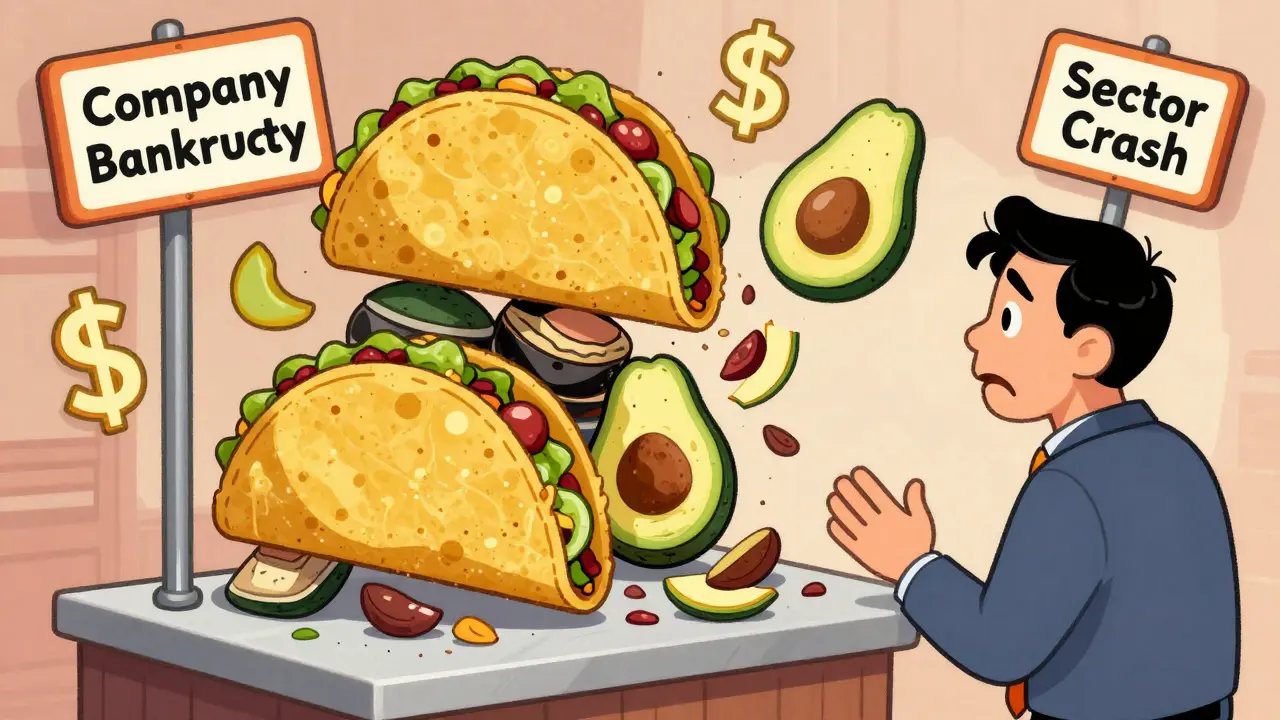
For decades, financial textbooks told investors that 15 to 20 stocks would cut your risk in half. That idea came from research in the 1970s and 80s, using simple measures like portfolio volatility over time. But here’s the problem: those studies didn’t look at what really matters to you - your final wealth after 10, 15, or 20 years. A 2003 study from the University of West Georgia changed that. They simulated portfolios over long time horizons and found something surprising: going from 10 to 20 stocks only cut the uncertainty of your ending wealth by 25%. But going from 10 to 50 stocks cut it by more than 50%. That’s not a small improvement - that’s the difference between ending up with $1.2 million or $800,000 after 20 years, even with the same average returns. Why does this happen? Because individual stocks can blow up. One company goes bankrupt. One CEO gets arrested. One product fails. If you only own 10 stocks, one bad apple can wipe out 10% of your portfolio. If you own 50, one failure is just 2%. That’s not just math - it’s peace of mind.The Real Risk: Not Volatility, But Terminal Wealth Dispersion
Most people think diversification is about smoothing out day-to-day price swings. It’s not. It’s about reducing the chance that your portfolio ends up way below what you expected. Take a portfolio of 10 stocks. Over 15 years, it might return 8% on average. But some of those portfolios end up with 3% returns. Others hit 13%. That’s a huge gap. Now take a portfolio of 50 stocks. The average is still 8%, but now almost all portfolios land between 7% and 9%. That’s what real diversification looks like - not less ups and downs, but more predictable outcomes. A 2021 paper by R. Raju, using data from the Indian market, showed that you need 40 to 50 stocks to reduce idiosyncratic risk (the risk that’s unique to one company) by 90%. That’s not a typo. In emerging markets, where company-specific risks are higher, you need even more. But even in the U.S., correlations between stocks have risen since 2000. In 2000, stocks moved independently 65% of the time. Today, they move together 65% of the time. That means you need more of them to offset each other.What the Experts Actually Recommend Today
Here’s what you’ll find if you dig into current research - not the old textbooks:- Statman (1987): 30 stocks for borrowing investors, 40 for lenders. Still cited, but based on outdated risk measures.
- University of West Georgia (2003): 50 stocks to cut terminal wealth uncertainty in half.
- Raju (2021): 40-50 stocks needed for 90% risk reduction in emerging markets.
- Alpha Architect (2023): 50-100 stocks for optimal risk-return balance. Says 20 stocks reduce volatility, but not return uncertainty.
- Edward Jones (2022): 25-30 stocks if equities make up half your portfolio. Less if you have other assets.
- Vanguard (2022): 20-30 stocks + ETFs = ideal for most retail investors.
More Stocks Isn’t Always Better
So is 100 stocks better than 50? Maybe not. Morningstar found that 68% of actively managed funds holding 30-50 stocks underperformed their benchmarks after fees. Why? Because adding more stocks means more trading, more research, more rebalancing. And that costs money. If you’re buying 100 individual stocks, you’re probably not doing deep research on each one. You’re just spreading yourself thin. There’s also the time cost. Financial Times estimates that managing 30+ individual stocks takes 15-20 hours a month. That’s a part-time job. If you’re working full-time, raising kids, or just don’t want to spend your weekends analyzing earnings calls, you’re better off with ETFs. And here’s the kicker: if you’re holding 100 stocks, you’re probably not reducing risk any further. The curve flattens after 50. The next 50 stocks add almost nothing to your safety. But they add a ton to your workload.Quality Over Quantity - And the 20-Stock Miracle
There’s one exception: optimized portfolios. In 2016, a study from the University of Akron built a 20-stock portfolio using minimum variance techniques - meaning they didn’t just pick random stocks. They picked the 20 that moved least together, had the lowest risk, and highest long-term potential. Between 2000 and 2015, that 20-stock portfolio turned $1 into $2.50. The S&P 500? Just $1.80. This isn’t magic. It’s math. When you use tools like optimization, you can get the same diversification with fewer stocks - but only if you’re smart about which ones you pick. Most people don’t do this. They just pick 20 stocks they like. That’s not diversification. That’s luck.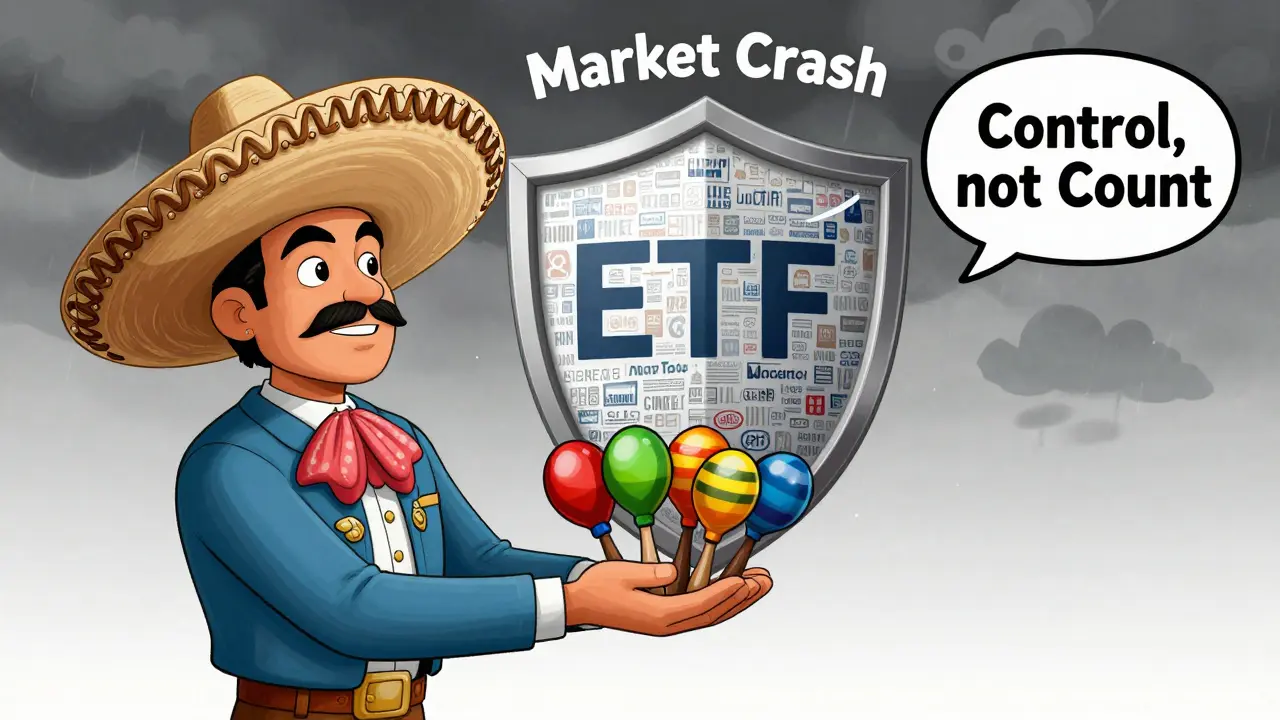
What Should You Do? A Practical Guide
Forget the number. Think in layers.- If you’re a hands-off investor: Use 1-2 broad market ETFs (like VTI or VOO). You’re diversified. Done.
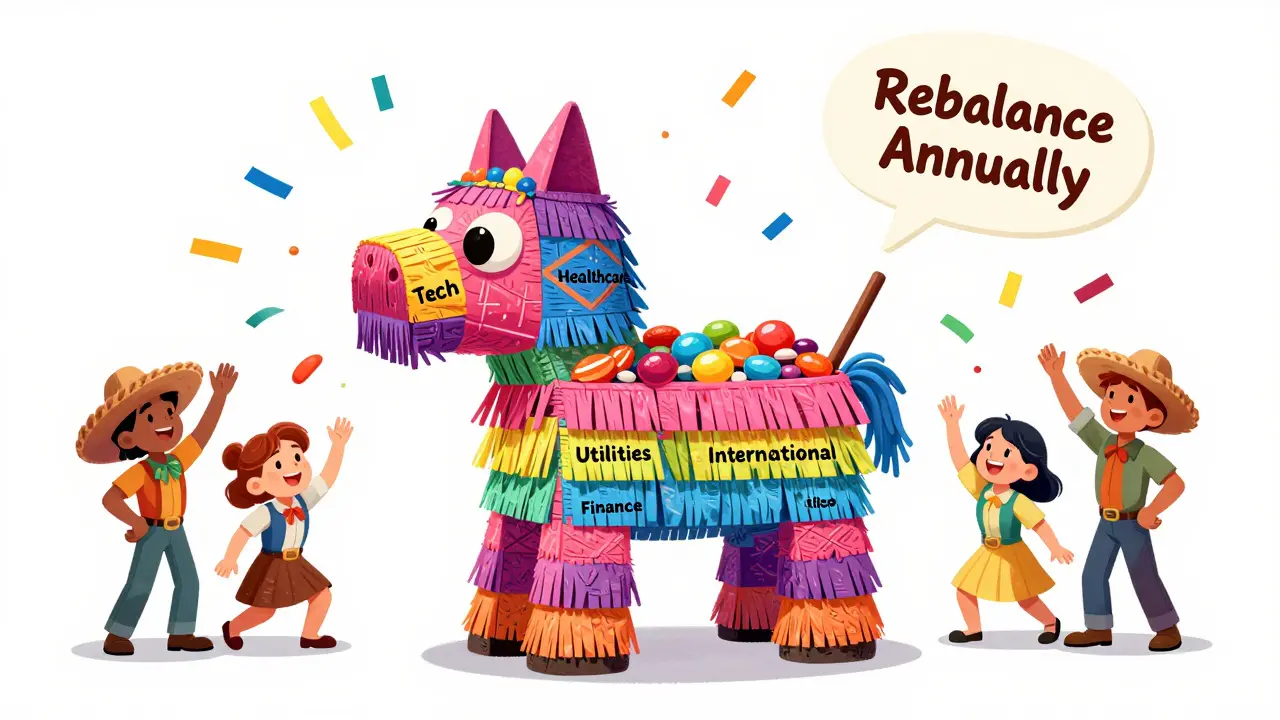
- If you’re an active investor with time: Start with 30-40 stocks. Spread them across sectors. No more than 5% in any one. No more than 15% in any one industry. Avoid tech-only or energy-only portfolios. Rebalance once a year.
- If you’re a factor investor: You can go lower - 20-30 stocks - but only if you’re targeting uncorrelated factors (value, quality, momentum). Don’t just pick cheap stocks. Pick cheap stocks that also have strong balance sheets and rising momentum.
- If you’re in an emerging market: Add 25-30% more stocks than you’d think. India, Brazil, Indonesia - those markets have higher company-specific risk. You need more bullets in the gun.
Hybrid Portfolios Are the New Standard
The most common portfolio today isn’t 100 stocks. It’s not one ETF. It’s a mix. A 2023 survey found that 82% of individual stock investors use both individual stocks and ETFs. The average? 12 individual stocks + 3-4 sector ETFs. That’s smart. You get the control of picking your favorite companies - Apple, Microsoft, Visa - and the safety of ETFs covering the rest (healthcare, utilities, international). You don’t need to pick 50 stocks. You just need to make sure you’re not betting everything on a few.Final Answer: 30-50 Stocks, With ETFs
There’s no perfect number. But based on the latest research, real-world data, and investor behavior, here’s the most practical answer:- Minimum for serious diversification: 30 stocks
- Optimal for risk reduction: 40-50 stocks
- Best for most people: 20-30 stocks + 2-3 broad ETFs
Is 10 stocks enough for diversification?
No. While 10 stocks may reduce some risk, research shows they leave you highly exposed to company-specific events. A 2003 study found that portfolios with 10 stocks had over 50% higher terminal wealth uncertainty than those with 50 stocks. In today’s market, where correlations are higher, 10 stocks won’t protect you from a sector crash or a single bad bet.
What’s the downside of owning too many stocks?
Owning 70+ stocks increases your workload without adding meaningful safety. Most investors can’t meaningfully research that many companies. It leads to shallow analysis, higher trading costs, and more frequent rebalancing. Morningstar found that funds with 30-50 stocks already underperform benchmarks after fees - adding more doesn’t help.
Should I use ETFs instead of individual stocks?
For most people, yes. ETFs give you instant diversification across hundreds of companies for a fraction of the time and cost. If you’re not spending 15+ hours a month researching companies, ETFs are the smarter choice. You can still add 10-20 individual stocks for personal conviction - but don’t let them dominate your portfolio.
Does diversification work in a market crash?
It works better than not diversifying, but not perfectly. In 2020, even broad market ETFs dropped 30%. But a diversified portfolio of 40+ stocks across sectors held up better than one focused on tech or energy. The key is that diversification doesn’t prevent losses - it prevents catastrophic ones. One company going bankrupt shouldn’t wipe out your portfolio.
How often should I rebalance my stock portfolio?
Once a year is ideal for most investors. More frequent rebalancing increases costs and taxes. Less frequent means you drift into overconcentration. Rebalancing isn’t about chasing performance - it’s about maintaining your original risk profile. If one stock has doubled and now makes up 12% of your portfolio, trim it back to 5% and reinvest elsewhere.
Don’t fixate on a number. Fixate on control. If you own 50 stocks and you know why you own each one - and you’re not emotionally tied to any single one - you’ve won. If you own 10 stocks and you’re terrified every time one drops 10%, you’ve lost - no matter what the textbooks say.
Royce Demolition
February 9, 2026 AT 12:52YO. 50 stocks? BRO. I just bought 3 ETFs and called it a day. 🚀💸 Why are we still arguing about individual stocks like it's 2008? The market's a wild ride-ETFs are your seatbelt. Stop overcomplicating. You’re not Warren Buffett. I’m not either. Let’s just get rich slowly. 🙌📈
Erika French Jade Ross
February 10, 2026 AT 18:24i just read this and thought… huh. maybe i’ve been overthinking this whole time. i’ve got like 18 stocks and 2 etfs and i’m sweating every time apple drops 2%. maybe i need less drama and more chill. 🤔🌱 also, typo: ‘recalibrate’ not ‘rebalence’ lol. but yeah. peace of mind > stock count.
Robert Shurte
February 12, 2026 AT 01:50There’s a quiet irony here: we seek diversification to avoid catastrophe, yet we obsess over the precise number of holdings-as if risk can be quantified like a grocery list. The 15-stock myth persists because it’s comforting. But risk isn’t a function of quantity-it’s a function of correlation, conviction, and cognitive load. The real question isn’t ‘how many?’ but ‘how deeply do you understand each one?’ If you can’t explain why you own it, you’re not diversified-you’re just… hoping.
And yes, ETFs are rational. But rationality doesn’t always soothe the soul. Some of us need to hold a few names-Apple, Visa, J&J-not because they’re safe, but because they’re familiar. That’s not irrational. It’s human.
Perhaps the goal isn’t to eliminate tail risk… but to live comfortably within it.
Mark Vale
February 13, 2026 AT 20:15Okay, so the government and big finance want you to think 50 stocks = safety. But what if they’re just trying to sell you more ETFs? 🤔 I mean, who really benefits when you stop picking stocks? The brokers. The ETF companies. The algorithms. Meanwhile, you’re just a data point in their portfolio optimization model. I’ve seen 3 companies in my portfolio go from $0 to $200 in 2 years. ETFs don’t give you that. They give you… mediocrity. And mediocrity is just slow poverty with a nice logo.
Don’t let them tell you ‘you’re too emotional.’ You’re not emotional-you’re awake. The 15-stock rule was a lie. The 50-stock rule? Probably just the next lie.
Stay suspicious. Stay selective. And if you’re not holding at least one stock that makes your palms sweat? You’re not investing. You’re just… parking.
Sabrina de Freitas Rosa
February 13, 2026 AT 23:24OMG I’m so done with people who act like they’re financial gurus because they read one paper. You don’t need 50 stocks. You need 5 stocks you actually LOVE. And one of them better be Amazon. Or Tesla. Or something that makes you feel like a genius when it goes up. If you’re holding 40 stocks just because some professor said so, you’re not investing-you’re doing homework. And nobody likes homework. Especially not after 3 p.m. on a Tuesday. Just pick a few winners, hold tight, and stop overthinking. You’re not a robot. You’re a human with money. Go spend it on something fun. 🍕