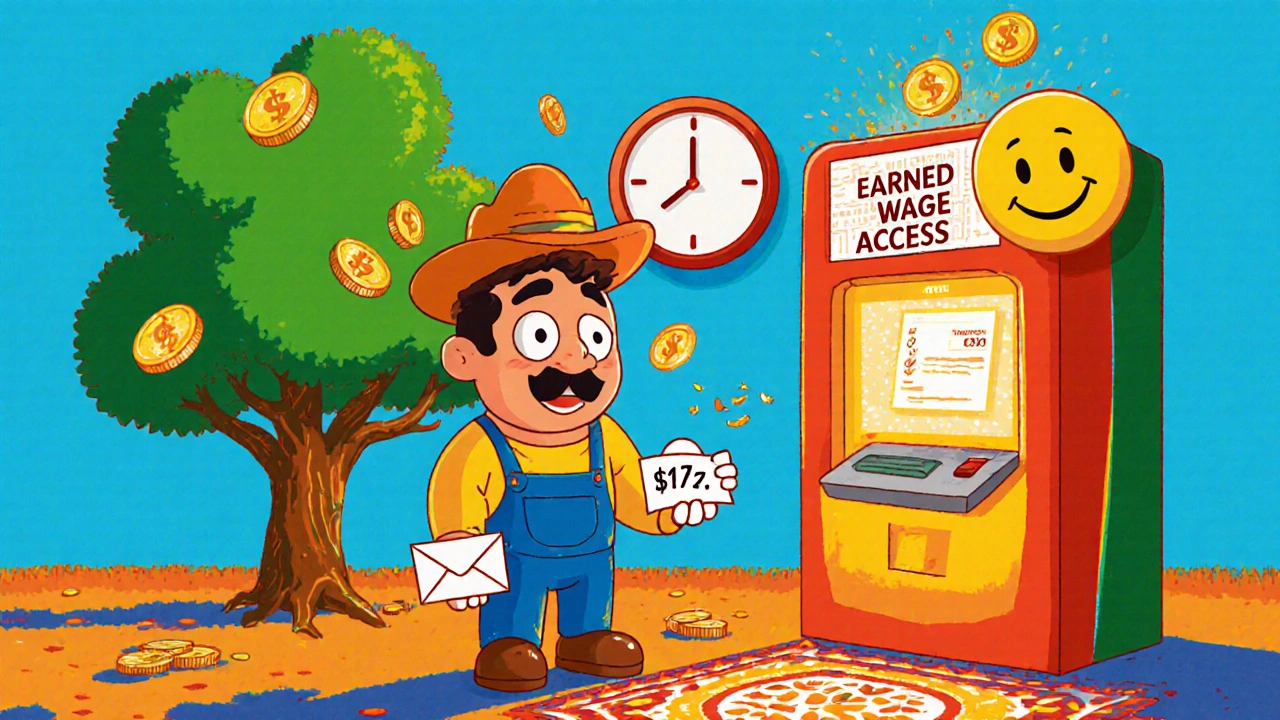
EWA vs. Payday Loan Cost Calculator
Calculate Your Cost Difference
See how much you could save by choosing earned wage access over a payday loan.
Earned Wage Access (EWA)
You're accessing money you've already earned. No interest, no debt cycle.
Payday Loan
Typical fees and rollovers create a debt trap.
Note: Payday loan fees compound quickly. In the example above, you would owe $100 plus $60 in fees for a $100 loan after 3 rollovers. That's a 99% cost difference compared to EWA.
Cost Comparison
95% cheaper with EWA
Imagine your car breaks down on a Friday night. You need $100 to fix it, but your next paycheck isn’t until Thursday. You’ve got $80 in your checking account. What do you do? If you’ve ever been in this spot, you’ve probably considered two options: a payday loan or earned wage access. One feels like a lifeline. The other feels like a trap. But here’s the truth - they’re not even the same thing.
What Earned Wage Access Really Is
Earned wage access (EWA), sometimes called on-demand pay, lets you get your own money - the money you’ve already worked for - before your regular payday. It’s not a loan. You’re not borrowing. You’re just moving up when you get paid. Think of it like this: you worked 20 hours this week. Your hourly rate is $15. That’s $300 earned. If your paycheck comes every other Friday, and today is Tuesday, you’ve already earned about $150. EWA lets you take that $150 now, not wait 10 more days. Most EWA services work through your employer. They connect directly to your company’s payroll system. When you log into the app, you see a number: “$127.50 available to withdraw.” You tap withdraw. The money hits your bank account in minutes (for a small fee) or in 1-3 days (for free). When payday comes, your employer deducts exactly what you took - no extra steps, no surprises. The fees? They’re tiny. Most providers charge $1 for a standard transfer. Instant access might cost $2 or $3. That’s it. No interest. No hidden charges. No rollovers. No debt cycle.How Payday Loans Work - and Why They Trap People
Payday loans are the opposite. You don’t get your own money. You borrow money you haven’t earned yet - and pay a steep price for it. You walk into a storefront or fill out an online form. They ask for your next paycheck stub. You write them a post-dated check or give them access to your bank account. They give you $100. You sign a contract saying you’ll pay back $115 in two weeks. That’s a 15% fee for two weeks. Sounds harmless? Let’s do the math. That 15% fee for two weeks equals a 391% annual percentage rate (APR). Most payday loans charge between 400% and 1,500% APR. That’s not a typo. That’s the norm. Here’s the trap: most people can’t repay it in two weeks. So they roll it over. Pay another $15 fee. Now they owe $130. Two more weeks pass. Roll it over again. Now it’s $145. Before you know it, you’ve paid $200 in fees for a $100 loan. And you’re still out the original $100. The Consumer Financial Protection Bureau found that the average payday loan borrower takes out eight loans a year. That’s not a one-time emergency. That’s a cycle. And it’s designed to keep you in it.Cost Comparison: $3 vs. $391
Let’s put this side by side. You need $100 now. Earned wage access: You pay $3 to get it now. You repay $100 when your paycheck hits. Total cost: $3. Payday loan: You pay $15 to get it now. You can’t repay it. You roll it over. You pay another $15. Then another. After three rollovers, you’ve paid $60 in fees. Still owe $100. Total cost: $160. That’s 99% cheaper with earned wage access. Not a little cheaper. Not “kinda cheaper.” 99% cheaper. A 2023 analysis by LevelFT found that employees using EWA instead of payday loans saved an average of $420 per year just in fees. That’s not a small number. That’s groceries. That’s gas. That’s a month’s phone bill.
Debt vs. Access: The Real Difference
This is the most important point: EWA doesn’t add debt. Payday loans create it. With EWA, you’re not borrowing money. You’re just getting your own money sooner. Your next paycheck covers it. No new balance. No interest. No credit check. No risk of overdrafts from automatic withdrawals you can’t afford. With payday loans, you’re taking on new debt. You’re promising to pay back more than you borrowed. And if you can’t? The lender tries to pull money from your account. If there isn’t enough? You get hit with overdraft fees from your bank - another $35 per hit. Now you’re paying the payday lender and your bank. The CFPB says 80% of payday loans are rolled over or followed by another loan within two weeks. That’s not an accident. That’s the business model. EWA, on the other hand, reduces that risk. A 2023 Willis Towers Watson survey found that employees with access to EWA were 40% less likely to use payday loans. And those who did use EWA reported lower stress, better focus at work, and fewer missed shifts.Employer Involvement: The Hidden Advantage
EWA doesn’t happen in a vacuum. It needs your employer to set it up. That’s actually a good thing. Because your employer is involved, the system is built on real pay data. No fake pay stubs. No guessing how much you made. The system knows exactly how much you’ve earned so far. That makes it accurate. Safe. Transparent. Payday lenders don’t care about your pay schedule. They don’t care if you get paid weekly or biweekly. They just want your bank info and your next payday. That’s why they’re so easy to abuse. Also, many employers pay for EWA as a benefit. That means you get it for free. Even when you pay a fee, it’s capped. No surprise charges. No fee escalations. No fine print.Who Should Use EWA - and Who Should Avoid Payday Loans
EWA is for people who:- Get paid regularly but live paycheck to paycheck
- Have unexpected expenses (car repair, medical co-pay, appliance breakdown)
- Want to avoid overdrafts and credit card cash advances
- Are tired of paying 400% interest on $100
- Don’t have access to EWA or other alternatives
- Believe they have no other options
- Are already deep in debt and don’t realize how fast it grows

Red Flags: When EWA Isn’t Really EWA
Not every company calling itself “earned wage access” is honest. Some providers disguise payday loans as EWA. They charge high fees. They require you to repay on a fixed schedule. They run credit checks. They report to credit bureaus. That’s not EWA. That’s a loan with a fancy name. Here’s how to tell the difference:- Does the service say “no interest” or “no credit check”? If not, walk away.
- Does the amount you can withdraw match your actual earned pay? If it’s higher than your hours times your rate, that’s a red flag.
- Do you have to repay on a specific date, or does it just get deducted from your next paycheck? If it’s a fixed date, it’s probably a loan.
- Is your employer involved? If you signed up directly online with no company connection, it’s likely not real EWA.
What’s Changing in 2025
EWA is growing fast. In 2020, only 17% of large employers offered it. By 2025, that number is expected to hit 60%. Payroll giants like ADP and Paychex now include it as a standard feature. More providers are adding savings tools. You can now set aside part of your earned pay into a separate account - even if you don’t withdraw it. Some even offer credit-building features that report your on-time withdrawals to credit bureaus. Meanwhile, payday lenders are losing ground. State laws are tightening. Public awareness is rising. And more people are choosing EWA because it doesn’t cost them their future.Final Thought: It’s Not About Borrowing. It’s About Fairness.
The real issue isn’t that people need money before payday. The issue is that the system forces them to pay hundreds of dollars to get it. Earned wage access fixes that. It doesn’t ask you to borrow. It doesn’t trap you. It just says: “You worked. You earned. Take it.” Payday loans say: “We’ll give you money - but you’ll pay more than you can afford to get it.” One helps you stay in control. The other takes it away. If you have access to EWA through your job - use it. If you don’t - ask your HR department. It’s not a perk. It’s a basic financial tool. And if you’re still using a payday loan? Stop. Find out if your employer offers EWA. If they don’t, talk to them. You’re not asking for a handout. You’re asking for fairness.Is earned wage access the same as a payday loan?
No. Earned wage access lets you take money you’ve already earned, with a small flat fee - no interest, no debt. Payday loans are actual loans that charge extremely high interest rates (often 400%+ APR) and trap borrowers in cycles of debt. EWA doesn’t add to your debt; payday loans create it.
Can I use earned wage access if my employer doesn’t offer it?
Most EWA services require employer sponsorship because they connect to your payroll system. If your employer doesn’t offer it, you can’t use a true EWA service. Be cautious of apps or websites that claim to offer “on-demand pay” without employer involvement - those are likely payday loans in disguise.
How much does earned wage access cost?
Most services charge $1 for a standard bank transfer (1-3 business days) and up to $3 for instant access. Some employers pay for it entirely, so it’s free for you. Even if you pay, it’s far cheaper than any payday loan - often 99% less expensive.
Do payday loans affect my credit score?
Most payday lenders don’t report to credit bureaus, so taking one won’t help your credit. But if you default and they sell your debt to a collector, that collector will report it - and that can tank your credit score. EWA doesn’t affect your credit at all, because it’s not a loan.
Is earned wage access safe for my privacy?
Your employer will know you used EWA and how much you took - but they won’t see why. Most platforms don’t share your spending details. However, 12% of users in a 2023 Payscale survey reported discomfort with their employer having visibility into their financial behavior. If privacy is a concern, ask your employer how data is handled before signing up.
What should I do if I’m already stuck in a payday loan cycle?
Stop rolling over the loan. Contact your lender and ask if you can pay off the principal in installments - many are required by law to offer this. Then, talk to your employer about EWA. Even if you can’t get it right away, use the next paycheck to pay down your balance. Look for nonprofit credit counseling agencies (like the National Foundation for Credit Counseling) - they can help you negotiate repayment plans for free.
Julia Czinna
November 27, 2025 AT 11:21I used to rely on payday loans when I was gig-working and got hit with an unexpected vet bill. The first time I saw EWA offered through my job, I thought it was too good to be true - until I tried it. Paid $1.50 to get $80 early, paid it back automatically on payday, and didn’t feel like I was drowning in debt afterward. It’s not magic, but it’s the closest thing to financial dignity I’ve ever had.
Still, I wish more employers offered it without making you jump through hoops. HR told me it’s ‘not a priority’ - like we’re not all one flat tire away from disaster.
Laura W
November 27, 2025 AT 22:45OMG YES. EWA is the fintech equivalent of a high-five from your bank. Payday loans? That’s financial Stockholm syndrome with a side of predatory APRs.
My cousin got trapped in a 7-loan cycle last year - $100 became $800 in fees. She didn’t even realize she was paying the same $100 back 8 times. When she finally got EWA through her new job? She cried. Not from joy - from rage that no one told her this existed before.
Also, employers who don’t offer EWA are basically outsourcing their workers’ financial trauma to loan sharks. That’s not a business model. That’s a moral failure.
RAHUL KUSHWAHA
November 28, 2025 AT 08:08From India, I’ve seen similar systems here - called ‘salary advance’ apps. But most charge 10-20% fees and hide it in fine print. Real EWA? It’s rare. But your post made me realize: even if it’s not perfect, it’s better than the 500% APR loans my uncle got stuck in.
My boss doesn’t offer it yet. I’ll ask next week. 😊
Dave McPherson
November 29, 2025 AT 12:43Oh sweet merciful Jesus, another virtue-signaling op-ed disguised as financial advice. Let me guess - you think EWA is the answer because it’s ‘not a loan’? Congrats, you’ve just rebranded cash advance as ‘earned wage access’ and slapped a $3 fee on it like it’s a gourmet coffee.
It’s still a structural Band-Aid on a broken wage system. You’re not fixing wage stagnation, you’re just making it easier for employers to pay you less because ‘hey, you’ve got on-demand pay!’
And don’t get me started on the ‘employer-sponsored’ angle. That’s not empowerment - that’s corporate surveillance wrapped in a neon ‘financial wellness’ sticker. Your employer now knows you’re broke on Tuesday and why. And they’re not your therapist.
Real solution? Raise the minimum wage to $25/hr and make employers pay overtime. Not this performative fintech theater.
Also, 99% cheaper? That’s mathematically true, but ethically irrelevant. You’re still paying $3 to access your own money. That’s a tax on being poor. And guess who collects it? The same tech bros who sold you crypto last year.
Graeme C
November 30, 2025 AT 14:35Dave, you’re right - EWA doesn’t fix the root problem. But you’re ignoring the reality that millions of people don’t have the luxury of waiting for systemic change.
While you’re debating wage policy over your artisanal cold brew, someone’s daughter needs insulin. Someone’s car is broken. Someone’s fridge is dead. They don’t care if EWA is ‘performative’ - they care if they can eat tomorrow.
And yes, employers should pay more. But until that happens, EWA is the only tool that doesn’t trap people in debt. It’s not perfect. It’s not revolutionary. But it’s the least terrible option on the table.
Calling it ‘corporate surveillance’ is hyperbolic. Your employer sees a number - $127.50 withdrawn. They don’t see if you bought gas, medicine, or a damn pizza. That’s not intrusion - that’s payroll integration.
And if you think $3 is a ‘tax on being poor,’ then tell me how much your credit card cash advance cost last time? Or your overdraft fee? Or your pawn shop loan? Because I’ve seen those numbers. They’re not $3.
EWA isn’t the solution. But it’s the first step. And if you’re too cynical to celebrate small wins, you’re part of the problem.