
CBDC Country Comparison Tool
Discover how different countries have implemented CBDCs with key metrics on adoption, privacy, and technical performance. Compare real-world results from the only four countries with fully live CBDCs.
Key Findings
Jamaica's JAM-DEX shows the highest adoption rate (68%) in rural areas, but the lowest privacy focus among the four countries.
Nigeria's eNaira has low adoption (20%) due to outages and invasive ID checks.
The Bahamas' Sand Dollar has the lowest adoption (2.3%) because users don't trust it and don't understand it.
Zimbabwe's ZiG shows moderate adoption (45%) but has very limited privacy features.
By December 2025, CBDC pilots are no longer experiments-they’re shaping the future of money. Over 130 countries are testing digital versions of their national currencies, but only four have fully launched them. This isn’t science fiction. It’s happening right now, in real cities, with real people, and real consequences for banks, businesses, and everyday users.
Who’s Leading the Pack?
China’s e-CNY is the undisputed leader. As of mid-2025, over 2.25 billion digital wallets have been created. That’s more than half the country’s population. People use it to pay for groceries, public transit, and even utility bills. The system handles 50,000 transactions per second during peak hours. It’s fast, reliable, and deeply integrated into apps like WeChat Pay and Alipay. But it’s not just about convenience. The government tracks every transaction. Privacy advocates worry. Users? Many don’t mind-as long as it works. Meanwhile, the Bahamas, Nigeria, Jamaica, and Zimbabwe are the only countries with fully live CBDCs. Jamaica’s JAM-DEX stands out. In rural areas where banks are scarce, 68% of users say it’s improved their lives. Faster payments. No more waiting days for checks to clear. But Nigeria’s eNaira? A different story. Users complain about constant outages and invasive ID checks. Adoption is low, and trust is lower.What Are These Pilots Actually Testing?
CBDC pilots aren’t just about replacing cash. They’re stress tests for the entire financial system. Governments want to know: Can money move faster? Can we reach the unbanked? Can we stop money laundering without crushing privacy? Australia’s Project Acacia is one of the most ambitious. It’s testing 24 real-world use cases-everything from settling carbon credits to trading private company shares. They’re using blockchain, but not the kind you think of with Bitcoin. It’s a private, permissioned system. Financial institutions are participating. Settlement times dropped by 40%. But integration took six months. And that’s just one project. Brazil’s DREX is aiming for a full launch in early 2025. It’s built on blockchain, too. Three pilot transactions have already gone through. The goal? Cut out middlemen in trade finance. Make it cheaper for small exporters to get paid. India’s digital rupee is a mess. Wholesale usage collapsed from INR109 million to just INR0.8 million in one year. Why? Banks didn’t see the benefit. The system was clunky. And the government never made it easy to use.Why the U.S. Is Stuck
The U.S. has the tech. The Federal Reserve has built Projects Hamilton, Cedar, and Agora-advanced systems ready for testing. But politics killed momentum. In March 2022, President Biden signed an order supporting digital currency research. Then, in January 2025, President Trump signed Executive Order 14178. It banned any government agency from “undertaking any action to establish, issue, or promote a CBDC.” Now, the Fed’s final assessment for Project Agora is due in January 2026. Will it be ignored? Will Congress step in? No one knows. The result? Uncertainty. Banks won’t invest. Startups won’t build. The U.S. is falling behind-not because of tech, but because of fear.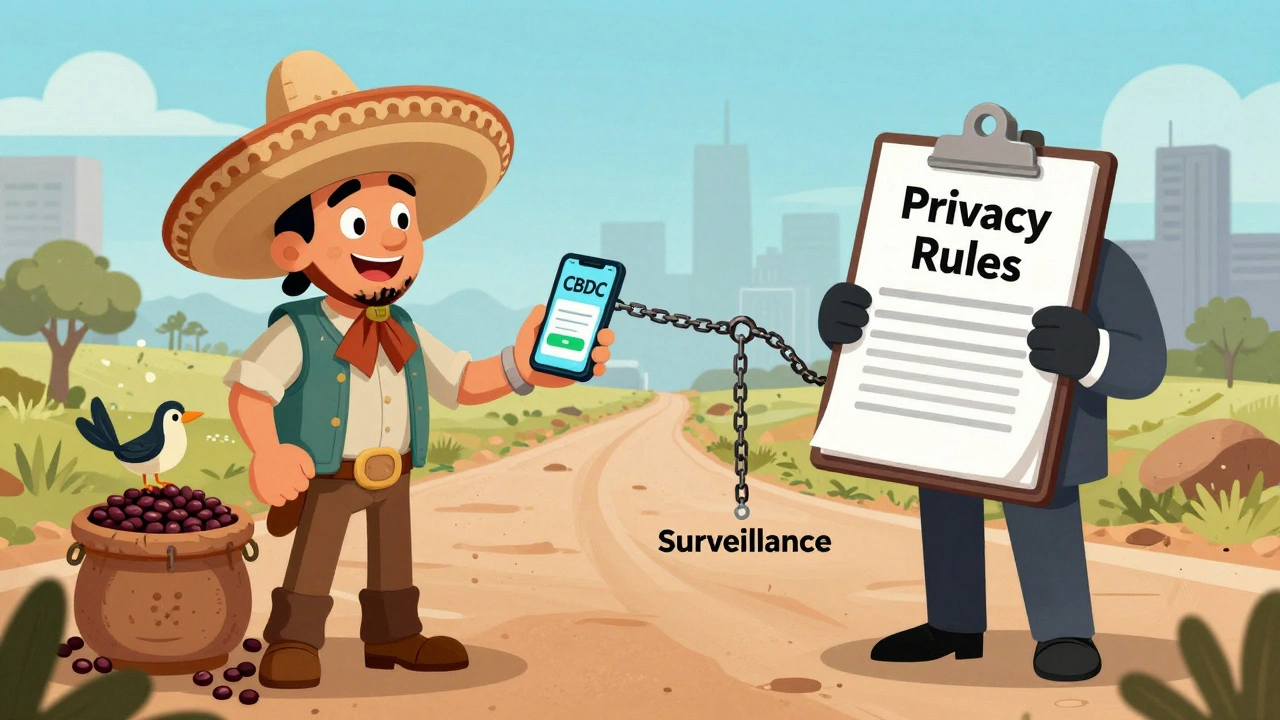
Privacy vs. Control
This is the biggest tension in every CBDC pilot. In Europe, 78% of people surveyed said they’re worried about government surveillance. That’s why the European Central Bank is insisting the digital euro must “complement cash, not replace it.” They’re setting strict holding limits. You won’t be able to store more than €3,000 in your digital wallet at once. That’s designed to stop people from pulling all their money out of banks during a crisis. In China, there are no such limits. The system is designed for control. Every payment is logged. That helps fight tax evasion and corruption. But it also means the state can see exactly what you buy, when, and from whom. The Bahamas’ Sand Dollar cost $12.7 million to build. Only 2.3% of the unbanked population adopted it. Why? People didn’t trust it. They didn’t understand it. And they didn’t see why they should give up cash for a government app.Enterprise Adoption Is Moving Faster Than Retail
Here’s the surprising truth: Businesses are adopting CBDCs faster than consumers. Why? Because it saves them money and time. In Australia, fixed-income settlements that used to take days now happen in seconds. That’s a 40% speed boost. For hedge funds and asset managers, that’s huge. In the mBridge project, China, Hong Kong, Thailand, and the UAE are testing direct CBDC-to-CBDC transfers across borders. No intermediaries. No currency conversion delays. No fees. This could replace SWIFT for trade finance. Sixty-three of the Global 100 financial institutions are now involved in at least one CBDC pilot. They’re not waiting for governments to catch up. They’re building the future themselves.
Why Most Pilots Are Failing
It’s not the tech. It’s the rollout. Here’s what goes wrong:- Legacy systems won’t talk to new tech. 71% of pilots struggle with integration. Banks still run on 30-year-old software. Upgrading costs 25% more than expected.
- Privacy rules get stuck in legal loops. 34% of projects are delayed over six months while lawyers argue over data laws.
- People don’t want to be tracked. Even in places with high smartphone use, users reject CBDCs if they feel monitored.
- Financial institutions resist. Banks fear losing deposits. If people move money to a CBDC, banks have less to lend. That hurts profits.
What’s Next? 2026 and Beyond
By the end of 2026, the IMF predicts 37 countries will move from pilot to full launch. The big milestones:- Europe’s digital euro will finalize its holding limits in December 2025. That’ll tell us if they’re serious about adoption or just playing it safe.
- Brazil’s DREX will go live in Q2 2025. If it works, other Latin American nations will follow.
- mBridge will expand from 4 to 12 countries. This could become the backbone of global trade.
- The U.S. will either abandon CBDCs-or quietly restart development after the 2026 election.
Is CBDC the Future-or a Mistake?
Agustin Carstens of the BIS says CBDCs are “reshaping how nations think about money.” That’s true. But Kenneth Rogoff from Harvard warns they could destabilize banks during crises. He’s right, too. The answer isn’t yes or no. It’s about balance. CBDCs can make payments faster, reduce fraud, and include the unbanked. But they can also enable mass surveillance and centralize too much power. The winners won’t be the countries with the most advanced tech. They’ll be the ones who get the trust right.Which countries have fully launched a CBDC?
As of December 2025, only four countries have fully launched operational CBDCs: the Bahamas (Sand Dollar), Nigeria (eNaira), Jamaica (JAM-DEX), and Zimbabwe (ZiG). All others are still in pilot or development phases. China’s e-CNY is the most advanced but remains a pilot, not a nationwide replacement for cash.
Why is China’s e-CNY so far ahead of other countries?
China’s e-CNY leads because of centralized control, massive public investment, and deep integration with existing digital payment platforms like WeChat Pay and Alipay. The government mandated adoption in public services, subsidized usage, and tested it in 26 cities with over 2.25 billion wallets created. Unlike Western countries, China prioritized speed and control over privacy, which accelerated adoption.
Are CBDCs the same as cryptocurrencies like Bitcoin?
No. CBDCs are digital versions of national currencies, issued and controlled by central banks. Bitcoin and other cryptocurrencies are decentralized, not backed by any government, and their value fluctuates. CBDCs are legal tender, just like paper money-but in digital form. They’re designed for stability, not speculation.
What’s the biggest risk of CBDCs?
The biggest risk is financial instability. If people lose trust in commercial banks during a crisis, they might move all their money into CBDCs. That could drain banks of deposits, making it harder for them to lend money to businesses and homeowners. Central banks are trying to prevent this by limiting how much CBDC individuals can hold-like capping digital wallets at €3,000 in Europe.
Why is the U.S. holding back on CBDCs?
The U.S. has the technical capability but is politically divided. President Biden supported research, but President Trump’s 2025 executive order banned any government action to create or promote a CBDC. This freeze has stalled progress. The Federal Reserve has built advanced prototypes, but without political backing, they can’t move forward. Public opinion is also split, with privacy concerns dominating the debate.
Will CBDCs replace cash?
Most central banks say no. The European Central Bank, Bank of Japan, and others insist CBDCs must complement cash, not replace it. But in practice, cash use is falling everywhere. If CBDCs become the default digital payment method, cash could fade out slowly-especially among younger generations. The real question isn’t whether CBDCs will replace cash, but whether society will accept a world with no physical money at all.
Robert Shurte
December 9, 2025 AT 17:50It’s fascinating-this isn’t just about money anymore. It’s about power. The moment a state can track every coffee purchase, every bus ride, every gift to a friend… we’ve crossed a line. Not because it’s evil, but because it’s inevitable. We traded anonymity for convenience decades ago, and now we’re reaping the consequences. The Chinese model isn’t just efficient-it’s a blueprint for authoritarian precision. And Europe? They’re trying to have it both ways: ‘We want control, but also freedom.’ Good luck with that. History doesn’t reward indecision.
Mark Vale
December 10, 2025 AT 02:01wait… so the fed built these super secure systems… and then trump just… shut it down? like… why? are we scared of our own gov or what? 🤔 i mean… if they can track every transaction… then they can also freeze your account if you say the wrong thing on twitter. this is 1984 but with qr codes. and dont even get me started on the ‘digital euro’ cap. €3000? like… what if you need to pay for a hospital bill? they think we’re dumb. they think we wont notice. we notice. we always notice.
Royce Demolition
December 10, 2025 AT 23:45YOOOOO THE FUTURE IS NOW!!! 🚀💸
Imagine paying for your tacos with a CBDC and your wallet auto-donates 1% to local food banks. Imagine small biz owners in Nigeria getting paid in SECONDS instead of weeks. Imagine global trade without banks taking 5% just to move money. This isn’t scary-it’s UPGRADE MODE! 🤖🌍
Stop being afraid of tech that helps people. The real threat? Doing nothing. Let’s build. Let’s innovate. Let’s make money WORK FOR US. #CBDCislife
Sabrina de Freitas Rosa
December 12, 2025 AT 22:05OMG. This is why I hate the government. They don’t care about you. They just want to control you. Look at Nigeria-people hate the eNaira because it’s glitchy and invasive. And China? They’re watching you buy tampons. Seriously? Who asked for this? And the US? Too chicken to even try. You’re all just puppets. The banks don’t want it because they’re greedy. The people don’t want it because they’re scared. And the politicians? They’re just playing politics with your life savings. Wake up. This isn’t progress. It’s a trap.
Erika French Jade Ross
December 12, 2025 AT 22:17